
Legacy App users can now access the Health Portal – just reset your password using email as username.

Can Peptides Or Nandrolone Help A Rotator Cuff Injury?
Can Peptides Or Nandrolone Help A Rotator Cuff Injury?

Viewing This Video Is A Member Exclusive Feature

But you don’t need membership to get Dr. O’Connor’s insight on this topic, it’s in the summary, key takeaways, and related drugs and conditions below.

Want to watch the full video? Join the Health Portal Today.

Join Now

Timeline

Timestamp
Topic
00:00
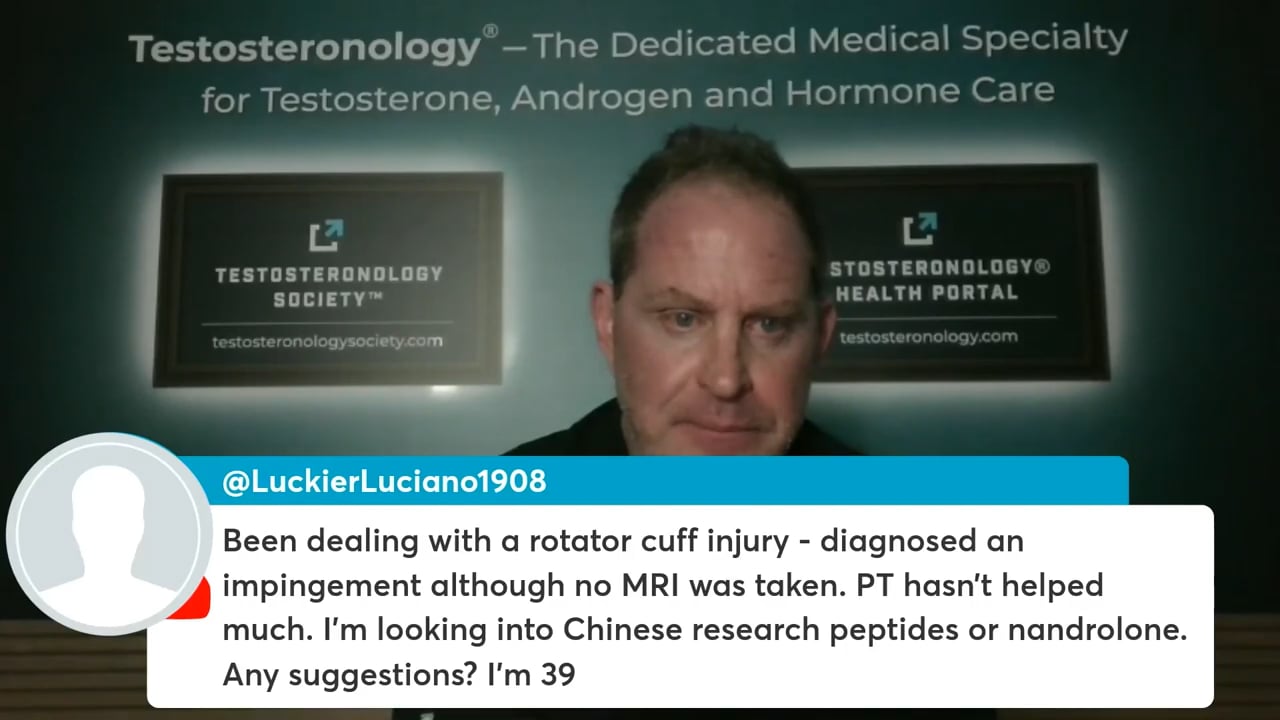
A 39-year-old man asks about research peptides or nandrolone for shoulder impingement. Dr. O’Connor discusses BPC-157 and TB-500, distinguishing anecdotal reports from clinical evidence and questioning safety, protocols, and sourcing.
02:30
The discussion shifts to nandrolone, shoulder symptoms, and the limitations of drug treatment for damaged tendons. Dr. O’Connor warns about natural testosterone suppression and possible sexual dysfunction.
05:10
Dr. O’Connor emphasizes that pain relief can encourage heavier training without resolving the injury. He discusses orthopedic assessment, imaging, and monitoring blood pressure and red blood cells when nandrolone is combined with testosterone.

Video Summary

A 39-year-old man asks whether research peptides or nandrolone could help his shoulder injury. He reports a diagnosis of impingement without an MRI and says physical therapy has helped. Dr. O’Connor discusses the proposed treatments while emphasizing uncertainty about the injury and the limits of medication-based approaches.

He begins with BPC-157 and TB-500, acknowledging interest in their potential effects but declining to recommend them. He distinguishes animal research and personal reports from reliable clinical evidence and raises questions about safety, dosing protocols, and product sourcing.

The discussion then turns to nandrolone and its possible effects on shoulder discomfort. Dr. O’Connor describes reports of symptom improvement but emphasizes that reduced pain does not establish that damaged tendon tissue has healed.

He also warns that nandrolone can suppress natural testosterone production and may cause sexual dysfunction. Although he assumes the questioner might be considering adding nandrolone to testosterone, the man’s current testosterone use is not confirmed.

The central concern is returning to heavy training because an injured shoulder feels better. Dr. O’Connor explains that symptom relief and increased strength may encourage loading that worsens an underlying injury. He recommends orthopedic assessment and consideration of imaging when structural tendon damage is suspected.

He closes by emphasizing the need for a clear treatment plan and monitoring of blood pressure and red blood cells when testosterone and nandrolone are combined. His take-home message is to distinguish pain relief from tissue recovery before relying on peptides or anabolic steroids for an injury.

Drug Callouts

Drug
Description
BPC-157
BPC-157 is an experimental peptide consisting of 15 amino acids that has been investigated for potential tissue-protective and repair effects. In this comparison of peptides with nandrolone for injury management, Dr. O’Connor declines to recommend it and emphasizes that animal findings and anecdotal improvement do not establish reliable human treatment outcomes.
TB-500
TB-500 is a synthetic peptide fragment related to thymosin beta-4, a protein involved in cellular processes associated with tissue repair. Dr. O’Connor considers it alongside BPC-157 as an alternative the questioner is weighing against anabolic steroid treatment, while emphasizing unanswered questions about safety, protocols, and sourcing.
Nandrolone
Nandrolone is an anabolic androgenic steroid related to testosterone that activates androgen receptors and can suppress luteinizing hormone signaling. Dr. O’Connor discusses possible shoulder pain relief when it is used with testosterone but warns that symptom masking, hormonal suppression, and increased training loads can complicate injury management.
Testosterone
Testosterone is the principal male androgen and is prescribed as replacement therapy for appropriately diagnosed testosterone deficiency. Here, Dr. O’Connor discusses it as the hormonal background to a possible nandrolone combination, without confirming the questioner’s current use or presenting that combination as a proven tendon-healing treatment.

Condition Callouts

Condition
Description
Shoulder Impingement
Shoulder impingement occurs when the space beneath the acromion narrows during arm movement, placing pressure on rotator cuff tendons and the surrounding bursa. In the discussion of adding nandrolone to testosterone, Dr. O’Connor emphasizes understanding the shoulder problem rather than using reduced pain as evidence that the injury has resolved.
Rotator Cuff Tendinitis
Rotator cuff tendinitis is irritation and inflammation of the tendons that help move and stabilize the shoulder. For men considering anabolic steroids for shoulder symptoms, Dr. O’Connor distinguishes relief of inflammatory discomfort from recovery of damaged tissue.
Rotator Cuff Tear
A rotator cuff tear is a partial or complete disruption of one or more tendons connecting the shoulder muscles to the upper arm bone. Dr. O’Connor warns that men using testosterone and nandrolone may feel stronger or less painful without resolving structural damage, making orthopedic assessment important before resuming heavy lifting.
Erectile Dysfunction
Erectile dysfunction is difficulty obtaining or maintaining an erection firm enough for sexual activity. Dr. O’Connor raises it as a potential complication of nandrolone use and warns that the drug can also suppress the body’s natural testosterone production.

Key Takeaways

  • Animal research and personal success stories do not establish that a peptide safely and effectively repairs an injured human tendon.
  • Shoulder impingement, tendon inflammation, and a rotator cuff tear are different problems, so identifying the injury matters before choosing treatment.
  • Reduced shoulder pain does not prove that damaged tendon tissue has healed or that heavy lifting is safe.
  • Nandrolone can suppress hormonal signals supporting natural testosterone production, so using it for joint discomfort is not a purely local pain-treatment decision.
  • Pain relief combined with steroid-related strength gains can encourage heavier training that aggravates an unresolved injury.
  • Adding nandrolone to testosterone requires attention to sexual function, blood pressure, red blood cells, and a clear treatment plan beyond short-term symptom relief.