
Why Does Scrotal Testosterone Cream Raise DHT?

Timeline
Video Summary
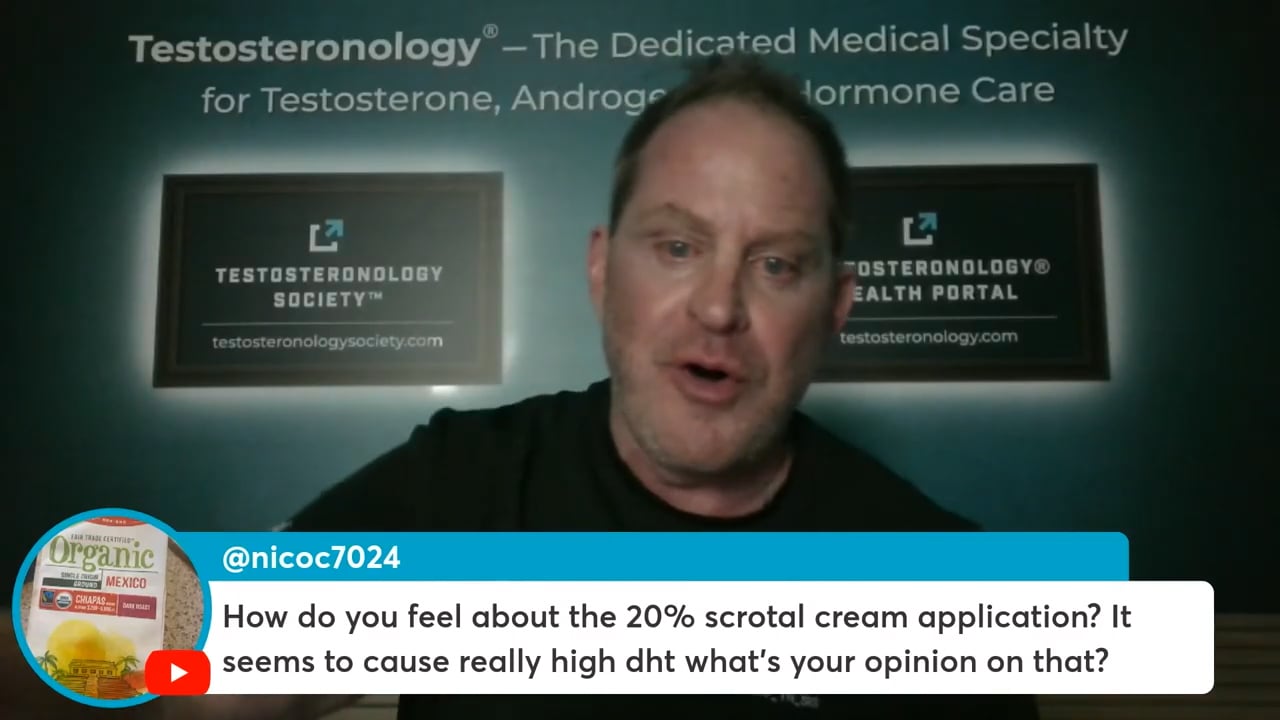
A 50-year-old man’s experience illustrates how scrotal testosterone cream can change DHT levels during TRT. Dr. O’Connor responds to a question about 20% cream and explains that scrotal application can produce substantial conversion of testosterone to dihydrotestosterone, or DHT.
He discusses increased sexual drive and potential hair loss, then distinguishes using cream as the testosterone delivery method from adding it to an existing injection regimen. His example involves a man with previous anabolic steroid use who is now using testosterone.
An unexpected estrogen increase prompts further discussion. Dr. O’Connor acknowledges that the finding needs interpretation rather than offering a confirmed explanation. He also raises proposed anti-estrogenic effects of Primobolan and Masteron, explicitly describing these ideas as potential or hypothesized.
The video then addresses a separate question about free testosterone at the trough, or lowest point before the next injection. Dr. O’Connor gives examples from his practice while emphasizing the lowest effective dose. His numerical examples are not universal targets because laboratory methods, units, and reference ranges differ.
He explains that testosterone measurements can vary despite an unchanged dose and discusses injection timing and absorption as contributors. He encourages interpreting patterns alongside symptoms rather than expecting identical results at every blood draw.
The closing discussion returns to the ABCDs™ framework, including A1C, blood pressure, cholesterol, cardiovascular health, and screening. The broader message is to evaluate hormone changes within ongoing medical care rather than pursue higher DHT or free testosterone numbers in isolation.
Drug Callouts
Condition Callouts
Key Takeaways
- Dr. O’Connor explains that applying testosterone cream to scrotal skin can substantially increase DHT, including when cream is added to an existing injection regimen.
- Increased DHT may heighten sexual drive but can also accelerate hair loss, a tradeoff Dr. O’Connor highlights when discussing scrotal testosterone cream.
- Dr. O’Connor describes the proposed anti-estrogenic effects of Primobolan and Masteron as potential or hypothesized rather than established.
- When assessing free testosterone at the trough, Dr. O’Connor emphasizes using the lowest effective dose rather than pursuing the highest possible level.
- Testosterone results can fluctuate despite an unchanged dose, and Dr. O’Connor identifies absorption differences and blood-draw timing as contributors to that variability.
- Long-term testosterone care should combine hormone results and how a man feels with monitoring of A1C, blood pressure, cholesterol, cardiovascular health, and appropriate screening.