
Legacy App users can now access the Health Portal – just reset your password using email as username.

Can A Man With Heart Disease Start Testosterone?
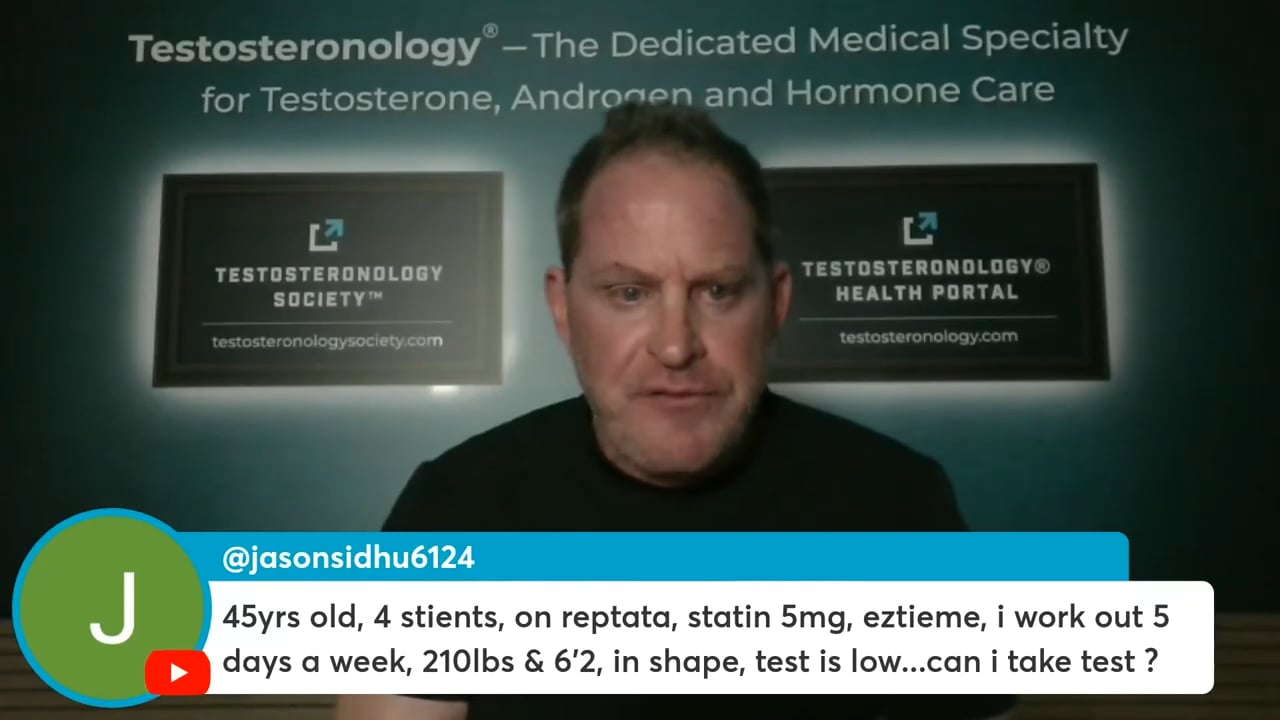
Can A Man With Heart Disease Start Testosterone?

Viewing This Video Is A Member Exclusive Feature

But you don’t need membership to get Dr. O’Connor’s insight on this topic, it’s in the summary, key takeaways, and related drugs and conditions below.

Want to watch the full video? Join the Health Portal Today.

Join Now

Timeline

Timestamp
Topic
00:00
A 45-year-old man with multiple coronary stents asks about testosterone treatment. Dr. O’Connor reviews cholesterol-lowering medications and emphasizes aggressive LDL management in established coronary disease.
02:00
The focus shifts to determining whether the man meets criteria for hypogonadism. Dr. O’Connor outlines hormone testing and a broader baseline assessment covering blood counts, metabolic health, lipids, prostate, thyroid, and urine findings.
04:35
Dr. O’Connor emphasizes the ABCDs™ framework, silent coronary plaque, and modifiable cardiovascular risks. He references TRAVERSE and returns to the need for individualized testosterone assessment and continued monitoring.
06:30
The discussion broadens to healthcare access and physician shortages. Dr. O’Connor encourages patients to participate actively in their care while continuing to work with qualified healthcare providers.

Video Summary

A 45-year-old man with multiple coronary stents asks whether low testosterone can be treated safely. He reports using Repatha and ezetimibe and describes being physically active. Dr. O’Connor emphasizes that his established heart disease requires a careful medical assessment rather than an immediate approval or rejection of TRT.

The discussion begins with cholesterol management. Dr. O’Connor explains Repatha’s role as a PCSK9 inhibitor and discusses combining cholesterol-lowering medications in patients with significant coronary disease. He proposes an LDL goal below 55 mg/dL for this scenario, while some details of the man’s medication regimen remain unconfirmed.

Before considering testosterone, Dr. O’Connor recommends evaluating whether the man meets the criteria for hypogonadism. He reviews a broad laboratory assessment, including total and free testosterone, LH, FSH, complete blood count, metabolic testing, A1C, lipids, prostate assessment, thyroid testing, and urinalysis.

He then emphasizes cardiovascular risk management through the ABCDs™ framework. Blood sugar, blood pressure, cholesterol, family history, smoking, and alcohol use all matter. He also discusses how coronary plaque may develop silently before a person requires stents.

Dr. O’Connor references the TRAVERSE trial when explaining why established cardiovascular disease does not automatically settle the testosterone decision. He directs the man to his clinicians for an individualized evaluation and ongoing monitoring rather than treating the trial as personal clearance.

The closing discussion addresses pressure on healthcare providers and the importance of taking an active role in obtaining appropriate care. The central message is that treating low testosterone must fit within a broader plan to protect cardiovascular and overall health.

Drug Callouts

Drug
Description
Testosterone
Testosterone is an androgen hormone used medically to replace deficient testosterone in men with certain forms of hypogonadism. Dr. O’Connor explains that this man’s low levels and coronary disease require an individualized assessment of treatment eligibility, cardiovascular health, and monitoring.
Repatha
Repatha, or evolocumab, is an injectable PCSK9 inhibitor that increases LDL cholesterol removal from the blood and reduces cardiovascular events in appropriate patients. Dr. O’Connor connects the man’s reported Repatha use with intensive cholesterol management after significant coronary disease.
Ezetimibe
Ezetimibe, also sold as Zetia, is a cholesterol-lowering medication that reduces cholesterol absorption in the intestine. Dr. O’Connor discusses its use alongside other lipid-lowering medications to help patients with coronary disease reach their LDL goal.
Statins
Statins are medications that reduce cholesterol production in the liver, lower LDL cholesterol, and help prevent cardiovascular events in appropriate patients. Dr. O’Connor describes a statin as part of a possible combination with Repatha and ezetimibe, although the questioner’s statin use is not confirmed.
Bempedoic Acid
Bempedoic acid is an oral ATP-citrate lyase inhibitor that lowers cholesterol by blocking its production in the liver. Dr. O’Connor identifies it as another lipid-lowering option but does not recommend adding it to this man’s reported regimen.

Condition Callouts

Condition
Description
Coronary Artery Disease
Coronary artery disease occurs when disease in the arteries supplying the heart reduces blood flow, commonly because of atherosclerotic plaque buildup. For men considering or using testosterone, Dr. O’Connor emphasizes that a history of coronary stents requires careful cardiovascular assessment and continued risk management.
Hypogonadism
Male hypogonadism is a condition in which the testes produce insufficient testosterone, sperm, or both. Before starting testosterone, Dr. O’Connor emphasizes confirming the questioner’s eligibility through clinical assessment and hormone testing rather than relying on the statement that his testosterone is low.
Hypertension
Hypertension is persistently elevated pressure within the arteries that increases the risk of heart, brain, and kidney damage. For men considering or using testosterone, Dr. O’Connor includes blood pressure assessment and control in the broader cardiovascular plan without assuming this man has hypertension.
Prediabetes
Prediabetes means blood glucose is above normal but below the range used to diagnose diabetes. For men considering or using testosterone, Dr. O’Connor highlights A1C and asks whether abnormal blood sugar contributed to the questioner’s cardiovascular risk.
Diabetes
Diabetes is a disease in which blood glucose remains too high because the body does not produce enough insulin or does not use it effectively. For men considering or using testosterone, Dr. O’Connor treats diabetes assessment as part of understanding cardiovascular risk rather than diagnosing it from this brief question.
Proteinuria
Proteinuria is excess protein in the urine and can indicate kidney damage. For men considering or using testosterone, Dr. O’Connor includes urine testing in the baseline assessment and specifically asks that possible proteinuria be considered.

Key Takeaways

  • A low testosterone result alone does not establish eligibility for TRT; diagnosis requires compatible symptoms and consistently low hormone measurements.
  • Coronary stents treat narrowed arteries, but ongoing cholesterol, blood pressure, blood sugar, and lifestyle management remain necessary to reduce future cardiovascular risk.
  • Cholesterol-lowering medications can work through different mechanisms: statins reduce production, ezetimibe reduces intestinal absorption, and Repatha increases LDL removal from the blood.
  • LH and FSH help evaluate the hormonal signals controlling testicular function, while free testosterone can clarify findings when total testosterone is difficult to interpret.
  • TRAVERSE studied medically supervised testosterone replacement in men with confirmed hypogonadism and cardiovascular disease or risk, so its findings do not provide blanket clearance for every patient or anabolic steroid regimen.
  • Evaluating TRT in a man with heart disease requires attention to blood counts, metabolic and kidney health, prostate considerations, and treatment response alongside testosterone levels.