
Legacy App users can now access the Health Portal – just reset your password using email as username.

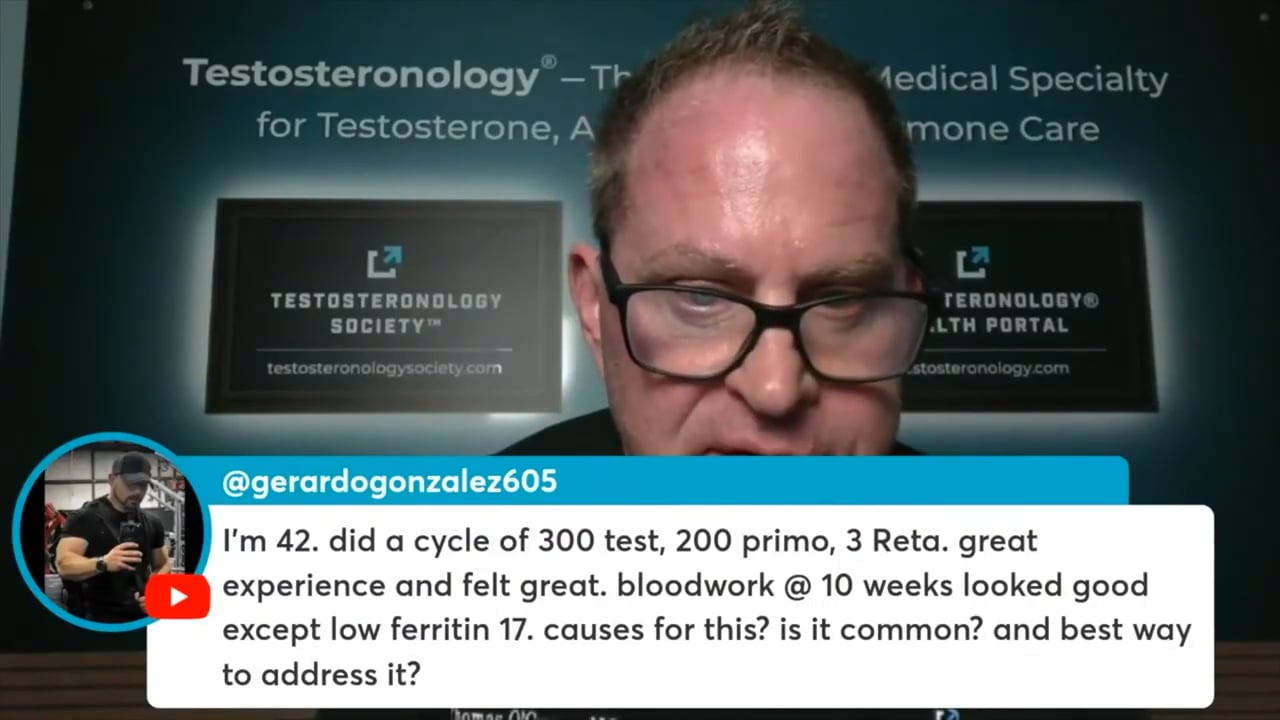
Why Is Ferritin Low After A Testosterone Cycle?
Why Is Ferritin Low After A Testosterone Cycle?

Viewing This Video Is A Member Exclusive Feature

But you don’t need membership to get Dr. O’Connor’s insight on this topic, it’s in the summary, key takeaways, and related drugs and conditions below.

Want to watch the full video? Join the Health Portal Today.

Join Now

Timeline

Timestamp
Topic
00:00
A 42-year-old man asks about low ferritin after a testosterone and Primobolan cycle. Dr. O’Connor asks about baseline ferritin, CBC results, iron saturation, gastrointestinal bleeding, and other medications before interpreting the finding.
01:30
Dr. O’Connor introduces Jardiance and its effects on hematocrit, then discusses competing influences on red blood cell production. He explains why CBC and iron studies should be reviewed together and highlights excessive phlebotomy as a possible contributor to low iron stores.
03:40
The discussion returns to the broader medical picture, including gastrointestinal bleeding, colon cancer family history, screening, and the ABCDs™ framework. Dr. O’Connor emphasizes that more information is needed for an individualized assessment.

Video Summary

A 42-year-old man reports low ferritin after a testosterone and Primobolan cycle. His bloodwork at 10 weeks otherwise looked reassuring, and he asks what caused the finding and how to address it. Dr. O’Connor emphasizes that ferritin alone is insufficient to determine the cause or choose a response.

He begins by asking about baseline ferritin, the complete blood count, iron levels, and iron saturation. He also raises gastrointestinal bleeding and other medications as possible contributors requiring further investigation.

The discussion expands to medications that affect hematocrit. Dr. O’Connor mentions Jardiance and explains that multiple influences on red blood cell production can complicate interpretation. He emphasizes reviewing the CBC alongside iron studies rather than focusing on one isolated result.

Dr. O’Connor describes stored iron being used to support increased red blood cell production during testosterone or anabolic steroid use. He distinguishes a modest decrease in ferritin from a broader pattern of low iron measurements and asks whether the man has been undergoing phlebotomy. Excessive phlebotomy is highlighted as a potential contributor to depleted iron stores.

He returns to the broader medical assessment, including gastrointestinal blood loss, family history of colon cancer, and appropriate screening. He references the ABCDs™ framework and concludes that additional laboratory results and medical history are needed before giving this man an individualized answer.

Drug Callouts

Drug
Description
Testosterone
Testosterone is part of the reported anabolic steroid cycle. Dr. O’Connor discusses its relationship to increased red blood cell production and the use of stored iron, emphasizing interpretation of ferritin alongside the CBC and other iron measurements.
Primobolan
Primobolan, referred to as Primo, is described as a DHT-derived anabolic steroid used alongside testosterone. The combination provides context for the man's question, but Dr. O’Connor does not establish Primobolan as the specific cause of his low ferritin.
Jardiance
Dr. O’Connor discusses Jardiance as an SGLT2 inhibitor with heart and kidney benefits and effects on hematocrit. He introduces it as another influence to consider when interpreting red blood cell findings, without establishing that the man asking the question takes it.

Condition Callouts

Condition
Description
Low Ferritin
Low ferritin is the laboratory finding reported by the man using testosterone and anabolic steroids. Dr. O’Connor emphasizes comparing it with baseline results, CBC findings, iron levels, iron saturation, and phlebotomy history before determining its significance.
Erythrocytosis
Erythrocytosis involves increased red blood cells and is discussed in relation to testosterone, anabolic steroids, and other medication effects. Dr. O’Connor emphasizes reviewing red blood cell findings together with iron studies and cautions about excessive phlebotomy.
Gastrointestinal Bleeding
Gastrointestinal bleeding is raised as a possible explanation for low iron stores in men using testosterone or anabolic steroids. Dr. O’Connor asks about blood loss rather than assuming the ferritin change is caused entirely by androgen use.
Colon Cancer
Colon cancer is discussed through family history and screening considerations. For men using testosterone or anabolic steroids who have low ferritin, Dr. O’Connor emphasizes including gastrointestinal health and family history in the broader assessment; he does not diagnose cancer in this case.

Key Takeaways

  • An isolated low ferritin result does not provide enough information to determine the cause or choose an appropriate response.
  • An isolated low ferritin result does not provide enough information to determine the cause or choose an appropriate response.
  • Dr. O’Connor describes increased red blood cell production during testosterone or anabolic steroid use as a potential reason stored iron is consumed.
  • Excessive phlebotomy can contribute to depleted iron stores and should be considered when reviewing low ferritin.
  • Medication effects, gastrointestinal bleeding, and colon cancer family history are part of the broader assessment.
  • Dr. O’Connor needs additional laboratory results and medical history before giving this 42-year-old man an individualized answer.