
Legacy App users can now access the Health Portal – just reset your password using email as username.

Should Men On TRT Take Aspirin To Prevent Clots?
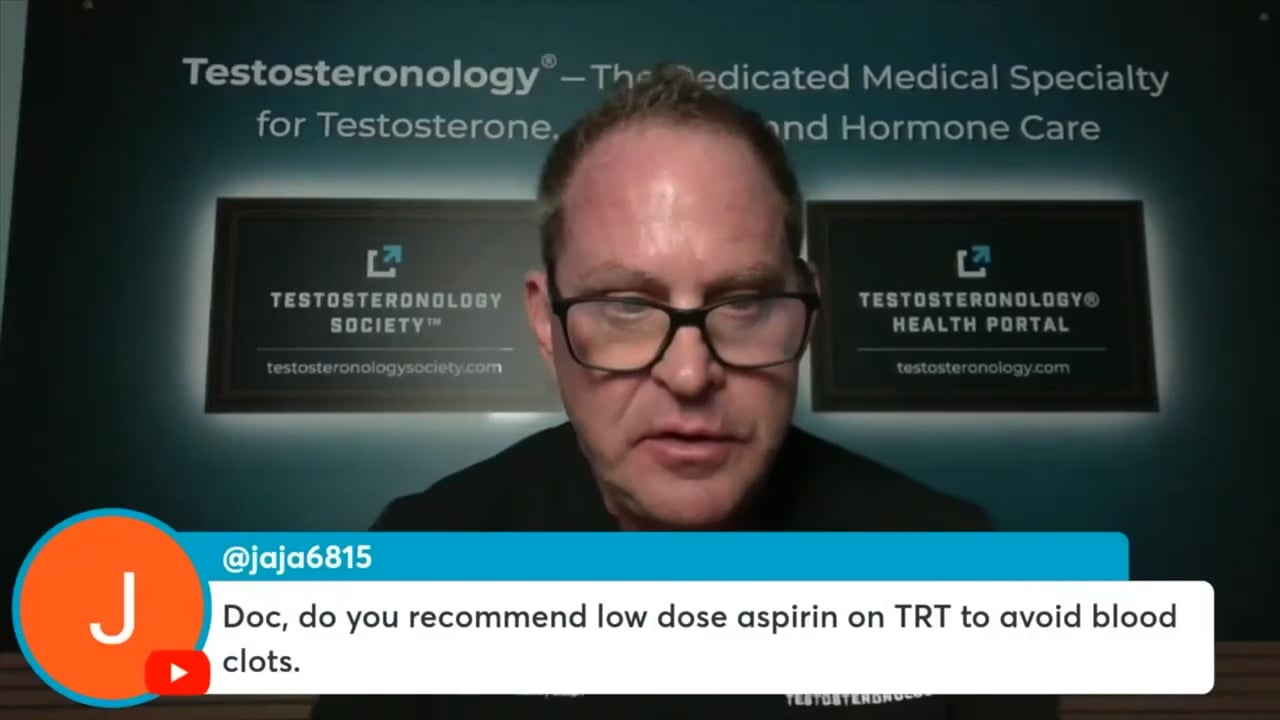
Should Men On TRT Take Aspirin To Prevent Clots?

Viewing This Video Is A Member Exclusive Feature

But you don’t need membership to get Dr. O’Connor’s insight on this topic, it’s in the summary, key takeaways, and related drugs and conditions below.

Want to watch the full video? Join the Health Portal Today.

Join Now

Timeline

Timestamp
Topic
00:00
Dr. O’Connor rejects routine aspirin use solely because a man takes testosterone. He discusses cardiovascular indications, antiplatelet treatment, bleeding risks, and individualized risk-benefit assessment.
02:25
The focus shifts to elevated red blood cells and polycythemia vera. Dr. O’Connor challenges extending aspirin practices from that disease to testosterone users and distinguishes red blood cell measurements from iron assessment.
04:10
Dr. O’Connor identifies androgen-induced erythrocytosis as the relevant term and emphasizes evaluating bleeding, inherited blood disorders, prior stroke, and cardiovascular history.

Video Summary

Taking testosterone does not automatically mean you should take low-dose aspirin. Dr. O’Connor explains why aspirin decisions require an individual assessment rather than a blanket recommendation for men on TRT or anabolic steroids.

He discusses established coronary artery disease, previous cardiovascular events, and bypass surgery as situations that can involve antiplatelet treatment. He mentions aspirin and Plavix while emphasizing that these decisions depend on the patient's cardiovascular history and risk.

Bleeding is central to the discussion. Dr. O’Connor warns about gastrointestinal bleeding and other serious bleeding complications, particularly in older adults and people with hypertension. He also mentions Lynch syndrome as a separate context in which aspirin may be considered.

The discussion then distinguishes polycythemia vera from androgen-induced erythrocytosis. Dr. O’Connor explains that polycythemia vera can involve multiple blood cell lines, whereas androgen-induced erythrocytosis concerns increased red blood cells. He challenges applying aspirin practices from polycythemia vera directly to testosterone-related red blood cell elevations.

He also distinguishes red blood cell measurements from iron assessment and mentions ferritin and iron saturation. He closes by emphasizing the broader medical picture, including bleeding, inherited blood disorders, prior stroke, and cardiovascular disease, when evaluating men using androgens.

Drug Callouts

Drug
Description
Aspirin
Low-dose aspirin is discussed as an antiplatelet medication whose potential benefits must be weighed against bleeding risks. Dr. O’Connor does not recommend it automatically for TRT use or testosterone-related red blood cell elevations.
Plavix
Dr. O’Connor mentions Plavix in the context of coronary artery disease and bypass surgery. He uses it to illustrate the complexity of antiplatelet treatment in patients with established cardiovascular disease.

Condition Callouts

Condition
Description
Androgen-Induced Erythrocytosis
Androgen-induced erythrocytosis refers to increased red blood cells associated with testosterone or anabolic steroid use. Dr. O’Connor distinguishes it from polycythemia vera and argues that it does not automatically justify aspirin.
Polycythemia Vera
Polycythemia vera is discussed as a blood malignancy that can involve red blood cells, platelets, and white blood cells. For men using testosterone or anabolic steroids, Dr. O’Connor emphasizes distinguishing this disease from androgen-induced erythrocytosis.
Coronary Artery Disease
For men on testosterone or anabolic steroids, established coronary artery disease and previous cardiovascular events are important parts of an aspirin assessment. Dr. O’Connor discusses bypass surgery and heart attack risk as relevant clinical considerations.
Gastrointestinal Bleeding
Gastrointestinal bleeding is a potential harm discussed when weighing aspirin use. For men on testosterone or anabolic steroids, Dr. O’Connor emphasizes that bleeding risk must be considered alongside any anticipated cardiovascular benefit.
Hypertension
Hypertension is relevant to the bleeding-risk assessment of men using testosterone or anabolic steroids. Dr. O’Connor specifically highlights elevated blood pressure when discussing potentially serious hemorrhagic complications.
Lynch Syndrome
Dr. O’Connor mentions Lynch syndrome in connection with inherited colon cancer risk and a separate potential role for aspirin. For men using testosterone or anabolic steroids, this is a distinct clinical consideration rather than a reason to take aspirin solely because of androgen use.

Key Takeaways

  • Dr. O’Connor does not recommend low-dose aspirin automatically for men taking testosterone or TRT.
  • Aspirin decisions require weighing cardiovascular benefit against bleeding risk for the individual patient.
  • Established coronary artery disease and previous cardiovascular events are relevant to antiplatelet treatment decisions.
  • Androgen-induced erythrocytosis and polycythemia vera are different conditions and should not be treated as interchangeable.
  • Dr. O’Connor challenges applying aspirin practices from polycythemia vera directly to testosterone-related red blood cell elevations.
  • Red blood cell findings, iron measurements, bleeding history, and underlying medical conditions require separate consideration.