
Legacy App users can now access the Health Portal – just reset your password using email as username.

Is 25 Mg Of Testosterone A Day Too Much?
Is 25 Mg Of Testosterone A Day Too Much?

Viewing This Video Is A Member Exclusive Feature

But you don’t need membership to get Dr. O’Connor’s insight on this topic, it’s in the summary, key takeaways, and related drugs and conditions below.

Want to watch the full video? Join the Health Portal Today.

Join Now

Timeline

Timestamp
Topic
00:00
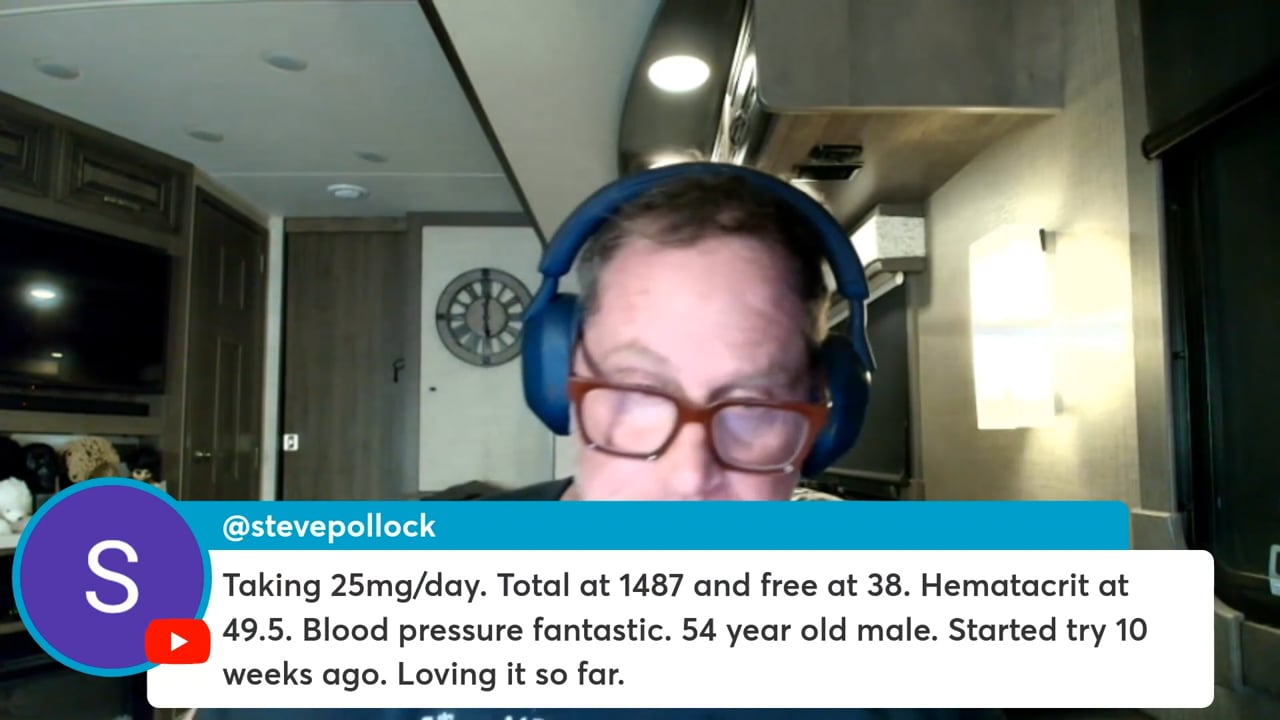
A 54-year-old man taking 25 mg of testosterone daily reports a total testosterone of 1,487 after 10 weeks, and Dr. O’Connor questions whether the dose is higher than necessary.
01:30
Dr. O’Connor explains how daily dosing of longer-acting testosterone cypionate or enanthate can accumulate and discusses subcutaneous testosterone enanthate and Xyosted as examples of alternative delivery approaches.
02:59
The discussion shifts beyond testosterone levels to blood pressure, cardiovascular screening, red blood cells, weight, sleep apnea, and how testosterone can worsen sleep-disordered breathing in susceptible men.
04:50
Dr. O’Connor emphasizes the ABCDs™ as the long-term framework for tracking A1C, blood pressure, cholesterol, and other health risks rather than focusing only on testosterone and free testosterone.

Video Summary

A 54-year-old man on daily testosterone asks whether 25 mg per day is too much. Dr. O’Connor reviews his total testosterone of 1,487, free testosterone of 38, hematocrit of 49.5, excellent blood pressure, and only 10 weeks of treatment.

He believes the daily dose may be excessive and explains that longer-acting testosterone esters such as cypionate and enanthate can accumulate when injected every day. Because the member has only recently reached steady state, Dr. O’Connor recommends looking beyond total and free testosterone to symptoms, SHBG, blood pressure, cardiovascular health, red blood cells, and the complete dosing pattern.

The discussion also emphasizes sleep apnea, weight, CPAP when appropriate, and the ABCDs™. Dr. O’Connor warns that testosterone can worsen sleep-disordered breathing and that red blood cell effects may become more apparent over time, making long-term monitoring more important than chasing a single testosterone number.

Drug Callouts

Drug
Description
Testosterone Cypionate
Testosterone cypionate is discussed as a likely formulation for daily microdosing. Dr. O’Connor explains that its roughly six- to seven-day half-life means daily injections can accumulate substantially, making dose and frequency important when interpreting high testosterone levels.
Testosterone Enanthate
Testosterone enanthate is discussed alongside cypionate as another longer-acting injectable formulation that can accumulate with daily dosing. Dr. O’Connor emphasizes understanding the ester half-life and reaching steady state before judging whether a TRT regimen is appropriate.
Xyosted (Testosterone Enanthate)
Xyosted is discussed as a subcutaneous testosterone enanthate auto-injector Dr. O’Connor uses in selected patients. He notes that subcutaneous delivery can be considered when individualizing TRT but does not imply that frequent dosing is necessary for every man.
Sustanon 250
Sustanon 250 is mentioned as another testosterone formulation that may be used outside the United States. Dr. O’Connor includes it while emphasizing that the specific ester mixture and pharmacokinetics must be considered when deciding how frequently testosterone should be administered.

Condition Callouts

Condition
Description
Sleep Apnea
Sleep apnea is discussed as an important condition to evaluate in men on testosterone because androgen exposure can worsen sleep-disordered breathing in susceptible individuals. Dr. O’Connor emphasizes weight reduction, appropriate testing, and CPAP when indicated rather than assuming a man does not have sleep apnea.
Androgen-Induced Erythrocytosis
Testosterone-related increases in red blood cell production are discussed as an effect that may become more apparent with longer treatment duration. Dr. O’Connor emphasizes following hematocrit over time rather than assuming a normal value after only 10 weeks guarantees that erythrocytosis will not develop.
Hypertension
Blood pressure is one of the first health markers Dr. O’Connor asks about when evaluating a man with high testosterone levels. Even though this member reports excellent blood pressure, ongoing monitoring remains important because TRT management should consider cardiovascular risk alongside hormone levels.

Key Takeaways

  • A daily testosterone dose of 25 mg may be excessive for some men, particularly when total testosterone is already substantially elevated.
  • Longer-acting testosterone esters can accumulate when injected every day because each new dose is added before previous doses have fully cleared.
  • A testosterone regimen should generally be evaluated after sufficient time at steady state rather than repeatedly changed during the early adjustment period.
  • Total testosterone, free testosterone, and SHBG should be interpreted alongside symptoms, dose timing, blood pressure, cardiovascular health, and red blood cell measurements.
  • Testosterone can worsen sleep-disordered breathing in susceptible men, making weight, sleep apnea evaluation, and CPAP important when appropriate.
  • Long-term TRT monitoring should extend beyond hormone levels to the ABCDs™, cardiovascular health, sleep, and androgen-induced erythrocytosis.