
Can You Use TRT With A Right Bundle Branch Block?

Timeline
Video Summary
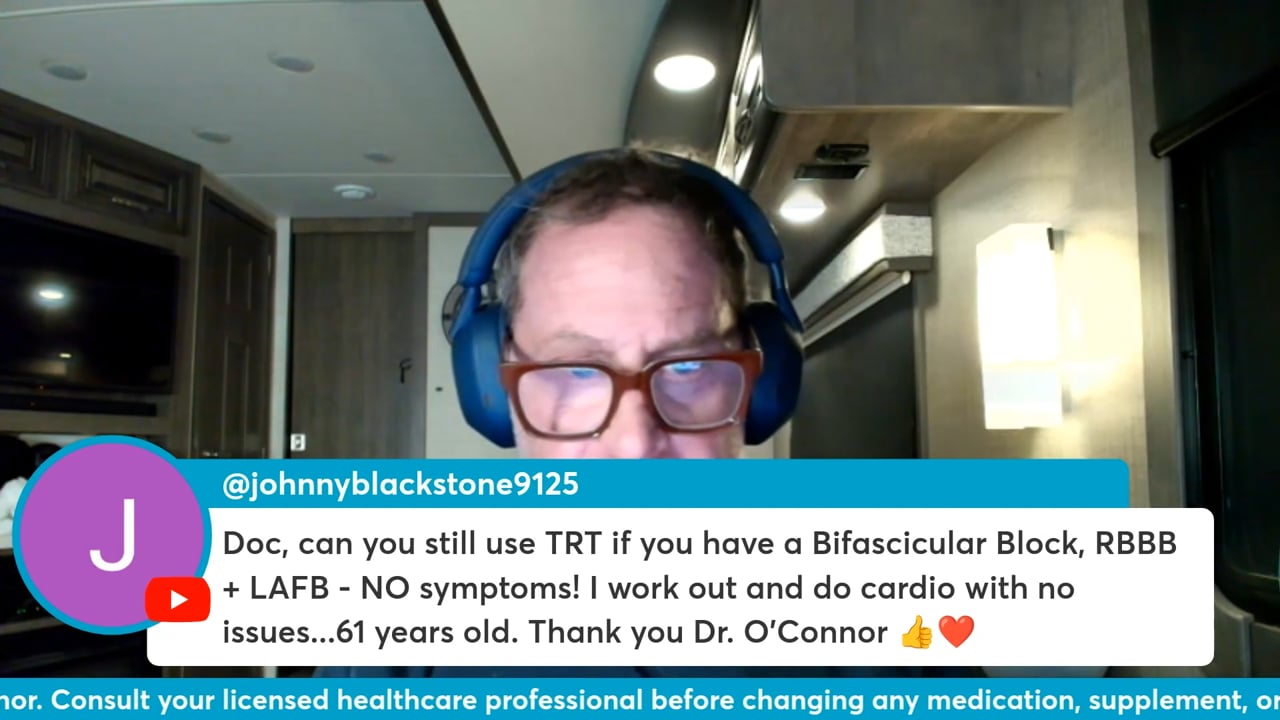
A 61-year-old man asks whether TRT is safe with a stable right bundle branch block. Dr. O’Connor explains that the conduction abnormality itself does not automatically rule out testosterone therapy, particularly when it has been stable and appropriately evaluated by cardiology.
He emphasizes determining whether underlying cardiovascular disease is present through blood pressure, A1C, coronary calcium scoring, stress testing when appropriate, electrocardiography, and a transthoracic echocardiogram. The evaluation should also consider cardiac structure, valves, ejection fraction, diastolic function, kidney disease, and proteinuria.
Dr. O’Connor also recommends assessing coronary risk with ApoB, Lp(a), and imaging rather than relying only on LDL cholesterol. If cardiology considers the heart condition stable, he does not view the bundle branch block alone as a reason to automatically exclude TRT.
Drug Callouts
Condition Callouts
Key Takeaways
- A stable right bundle branch block does not automatically mean a man cannot use testosterone therapy.
- Cardiology evaluation should determine whether underlying coronary disease or structural heart disease is present before making TRT decisions.
- A transthoracic echocardiogram can evaluate cardiac structure, valves, ejection fraction, and diastolic function.
- Blood pressure and A1C remain important cardiovascular risk markers when evaluating an older man on testosterone.
- Coronary calcium imaging, ApoB, and Lp(a) can provide cardiovascular information beyond a standard LDL cholesterol measurement.
- If the conduction abnormality is stable and the cardiovascular evaluation is reassuring, Dr. O’Connor does not consider it an automatic reason to withhold TRT.