
Legacy App users can now access the Health Portal – just reset your password using email as username.

Should You Stop Over-Phlebotomizing On Testosterone?
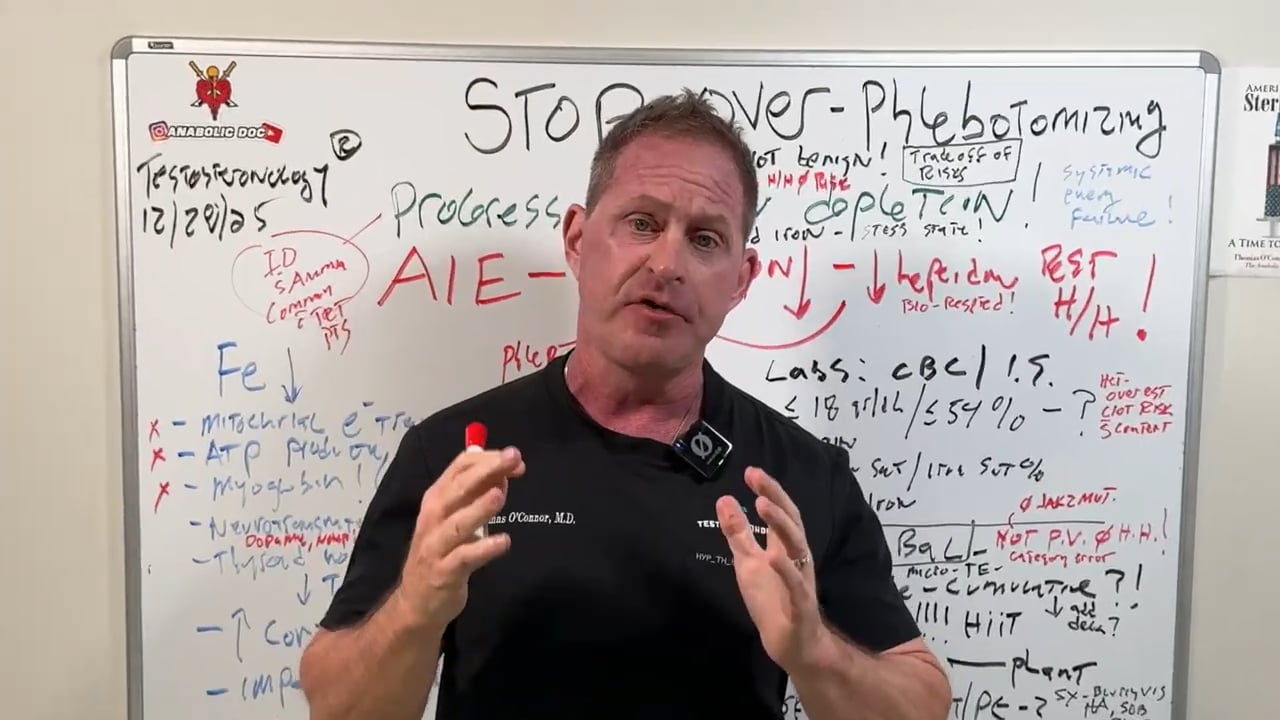
Should You Stop Over-Phlebotomizing On Testosterone?

Viewing This Video Is A Member Exclusive Feature

But you don’t need membership to get Dr. O’Connor’s insight on this topic, it’s in the summary, key takeaways, and related drugs and conditions below.

Want to watch the full video? Join the Health Portal Today.

Join Now

Timeline

Timestamp
Topic
00:00
Dr. O’Connor explains why automatically phlebotomizing men on testosterone based only on hemoglobin and hematocrit can create a major clinical error when iron balance and individual risk are ignored.
02:30
The mechanism of androgen-induced erythrocytosis is explained through increased erythropoietin, suppressed hepcidin, greater iron utilization, and a new hemoglobin and hematocrit set point in men using testosterone.
05:55
Dr. O’Connor explains how repeated phlebotomy can further stimulate erythropoietin while progressively depleting iron, creating a cycle in which men continue giving blood without correcting the underlying androgen-driven process.
08:40
Iron depletion without anemia is discussed as a common problem in TRT clinics, with possible effects on energy production, cardiovascular response, cognition, sleep, neurotransmitters, thyroid function, and exercise capacity.
14:35
Dr. O’Connor reviews CBC and iron studies together and emphasizes distinguishing testosterone-related erythrocytosis from polycythemia vera, hereditary hemochromatosis, bleeding, inflammation, and other causes of abnormal blood or iron measurements.
24:40
The presentation turns to restoring balance by reducing cumulative androgen exposure, considering microdosing or less erythrocytosis-promoting formulations, addressing sleep apnea and body weight, maintaining hydration, and individualizing phlebotomy.

Video Summary

Men on testosterone can become iron depleted when repeated phlebotomy is used to control erythrocytosis. Dr. O’Connor explains how androgens stimulate erythropoietin, suppress hepcidin, increase red blood cell production, and alter the way the body uses circulating iron.

Repeated blood removal can create a vicious cycle in which erythropoietin remains stimulated while ferritin and other iron measures progressively decline. Even without anemia, iron depletion may contribute to fatigue, weakness, brain fog, restless legs, impaired exercise capacity, and other symptoms that can be missed when clinicians look only at hemoglobin and hematocrit.

Dr. O’Connor recommends evaluating the CBC together with ferritin, transferrin saturation, total iron, symptoms, testosterone dose, sleep apnea, genetics, clot history, cardiovascular health, and the broader ABCDs™. He also stresses distinguishing androgen-induced erythrocytosis from conditions such as polycythemia vera and hereditary hemochromatosis before deciding whether phlebotomy is actually necessary.

Drug Callouts

Drug
Description
Testosterone
Testosterone is the central androgen discussed because it stimulates erythropoietin, suppresses hepcidin, increases red blood cell production, and can lower circulating iron stores through increased utilization. Dr. O’Connor emphasizes reducing excessive cumulative exposure and individualizing the formulation and dose when erythrocytosis becomes difficult to manage.
Deca-Durabolin (Nandrolone)
Nandrolone is discussed as an additional androgen that can amplify testosterone-related erythrocytosis when the two are combined. Dr. O’Connor cautions that men already struggling with elevated red blood cell measurements may worsen the problem by adding Deca and then relying on repeated phlebotomy.

Condition Callouts

Condition
Description
Androgen-Induced Erythrocytosis
Androgen-induced erythrocytosis is the central condition in this presentation and results from testosterone and other androgens stimulating red blood cell production through erythropoietin, hepcidin, iron utilization, and related mechanisms. Dr. O’Connor emphasizes that management should consider symptoms, iron status, androgen dose, cardiovascular risk, sleep apnea, genetics, and clot history rather than one hematocrit threshold.
Iron Depletion
Iron depletion can develop in men on testosterone when increased iron utilization is compounded by repeated phlebotomy. Dr. O’Connor explains that significant depletion may occur even without anemia and can contribute to fatigue, weakness, brain fog, sleep problems, impaired exercise performance, and other systemic symptoms.
Hereditary Hemochromatosis
Hereditary hemochromatosis is discussed as an important genetic condition that can dramatically change iron management in a man using testosterone. Dr. O’Connor emphasizes identifying true iron overload because these patients may require a very different phlebotomy strategy from men whose iron stores are already depleted.
Polycythemia Vera
Polycythemia vera is discussed as a bone-marrow disorder associated with JAK2 mutations that should not be confused with the secondary erythrocytosis commonly caused by testosterone. Dr. O’Connor considers distinguishing these conditions essential before deciding how elevated hemoglobin and hematocrit should be treated.
Sleep Apnea
Sleep apnea can add a hypoxic stimulus that further increases erythropoietin and red blood cell production in men already using testosterone or anabolic steroids. Dr. O’Connor includes identifying and treating sleep apnea among the ways to reduce the total erythrocytotic drive.
Venous Thromboembolism
DVT and pulmonary embolism are discussed when evaluating whether elevated red blood cell measurements actually translate into clot risk for a man on testosterone. Dr. O’Connor emphasizes considering genetics, immobility, surgery, endothelial injury, inflammation, prior clot history, and the other components of Virchow’s triad rather than hematocrit alone.

Key Takeaways

  • Men on testosterone should not be repeatedly phlebotomized solely because hemoglobin or hematocrit exceeds a predetermined threshold.
  • Testosterone can increase erythropoietin, suppress hepcidin, increase red blood cell production, and simultaneously increase the body’s utilization of iron.
  • Repeated phlebotomy can create progressive iron depletion even when hemoglobin and hematocrit remain elevated and the patient is not anemic.
  • CBC results should be interpreted together with ferritin, transferrin saturation, total iron, symptoms, androgen exposure, and the individual’s broader health risks.
  • Androgen-induced erythrocytosis should not be confused with polycythemia vera or hereditary hemochromatosis because these conditions require different evaluation and management.
  • Reducing cumulative androgen exposure, addressing sleep apnea and body weight, maintaining hydration, and individualizing phlebotomy may help restore a more sustainable balance.