
Legacy App users can now access the Health Portal – just reset your password using email as username.

Which Testosterone Formulation Is Best For TRT?
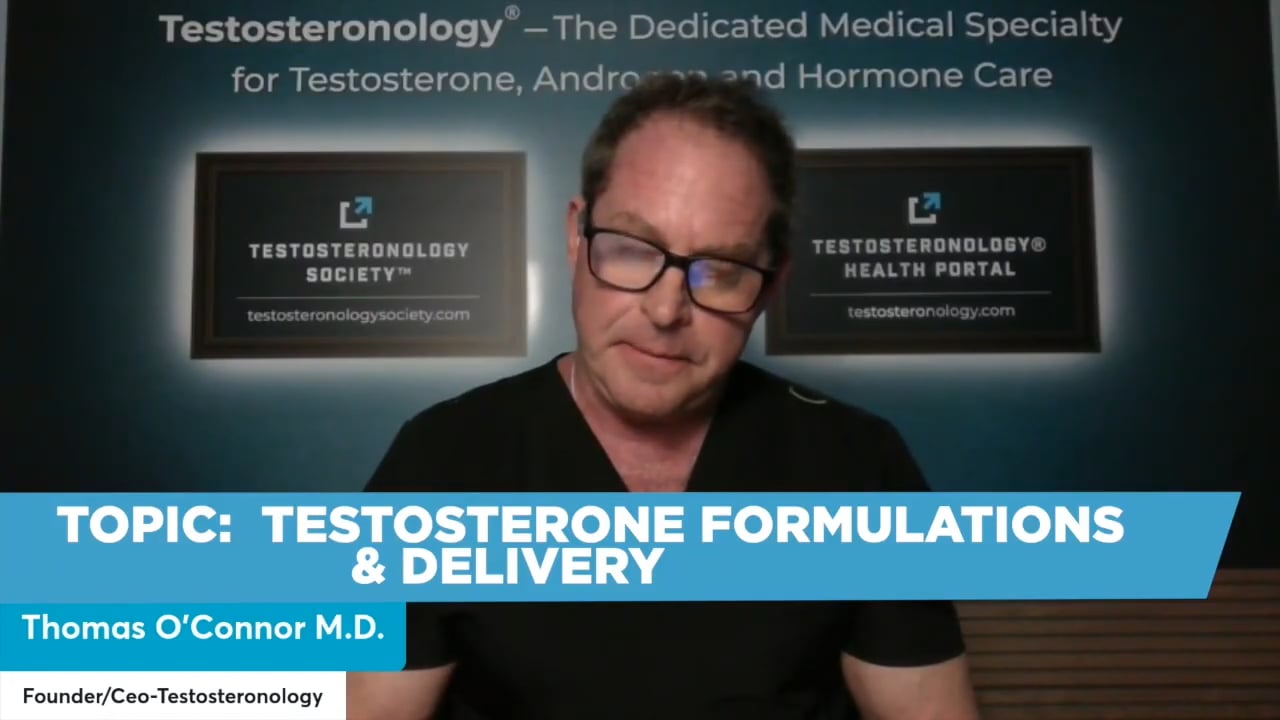
Which Testosterone Formulation Is Best For TRT?

Viewing This Video Is A Member Exclusive Feature

But you don’t need membership to get Dr. O’Connor’s insight on this topic, it’s in the summary, key takeaways, and related drugs and conditions below.

Want to watch the full video? Join the Health Portal Today.

Join Now

Timeline

Timestamp
Topic
08:40
Dr. O’Connor discusses why starting TRT at 200 mg of testosterone cypionate weekly may be excessive for many men and introduces the importance of formulation, carrier oil, dosing, and individual response.
10:10
Testosterone enanthate is compared with cypionate, including similar dosing intervals, half-life, microdosing, nonlinear pharmacokinetics, accumulation, peaks, troughs, and why daily injections may not always produce the expected flat testosterone level.
12:20
Dr. O’Connor reviews Xyosted, a subcutaneous testosterone enanthate auto-injector, and explains how subcutaneous versus intramuscular delivery may influence absorption, blood supply, dosing frequency, and individual pharmacokinetics.
14:30
The concept of drug half-life is explained in practical terms, including steady state, peak and trough levels, dosing frequency, and why long-acting testosterone esters behave very differently from short-acting medications.
17:00
Dr. O’Connor compares short-acting testosterone propionate with long-acting testosterone undecanoate, including Nebido, and explains why shorter half-lives may provide more control while very long-acting formulations can produce prolonged peaks and troughs.
21:46
The presentation moves through testosterone pellets, topical creams and gels, scrotal application, transdermal transfer risk, nasal testosterone, and oral testosterone undecanoate while comparing convenience, dosing frequency, and practical limitations.

Video Summary

Testosterone formulations differ dramatically in half-life, delivery, dosing frequency, and how consistently men feel on TRT. Dr. O’Connor compares testosterone cypionate, enanthate, propionate, undecanoate, Sustanon 250, subcutaneous formulations, pellets, transdermal products, nasal testosterone, and oral testosterone undecanoate.

He explains how ester half-life, injection frequency, concentration, route of administration, metabolism, peaks, troughs, and steady state can all affect the experience of testosterone therapy. Dr. O’Connor also discusses why very frequent microdosing of longer-acting esters may sometimes produce more accumulation than expected and why shorter-acting formulations can offer greater control for some men.

The presentation also reviews practical differences among Xyosted, Nebido, Sustanon 250, pellets, topical testosterone, and oral testosterone undecanoate. Throughout the discussion, Dr. O’Connor emphasizes individual pharmacokinetics, symptoms, laboratory values, blood pressure, red blood cells, estrogen, DHT, mood, sexual function, and other health effects when selecting and adjusting TRT.

Drug Callouts

Drug
Description
Testosterone Cypionate
Testosterone cypionate is discussed as one of the most common injectable TRT formulations, with Dr. O’Connor emphasizing its roughly week-long pharmacokinetics, individualized dosing, peaks and troughs, and the potential for excessive accumulation when longer-acting testosterone is microdosed too frequently.
Testosterone Enanthate
Testosterone enanthate is described as very similar to cypionate with a somewhat shorter half-life and comparable dosing intervals. Dr. O’Connor discusses both intramuscular and subcutaneous use and emphasizes adjusting frequency according to symptoms, laboratory results, and individual metabolism.
Xyosted (Testosterone Enanthate)
Xyosted is discussed as a subcutaneous testosterone enanthate auto-injector available in fixed doses. Dr. O’Connor explains that subcutaneous delivery may alter absorption compared with intramuscular injection because adipose tissue has less blood supply.
Testosterone Propionate
Testosterone propionate is presented as a shorter-acting ester with a substantially shorter half-life than cypionate or enanthate. Dr. O’Connor considers the shorter duration useful when a man wants more frequent adjustment and less prolonged accumulation.
Testosterone Undecanoate
Testosterone undecanoate is discussed in both long-acting injectable and short-acting oral formulations. Dr. O’Connor contrasts injectable Nebido’s very prolonged kinetics with oral testosterone undecanoate, which requires frequent dosing and behaves very differently despite containing the same testosterone ester.
Sustanon 250
Sustanon 250 is discussed as a four-ester testosterone formulation used for TRT and bodybuilding outside the United States. Dr. O’Connor emphasizes its 250 mg-per-milliliter concentration and warns that dosing volume should not be assumed equivalent to 200 mg-per-milliliter cypionate or enanthate.

Condition Callouts

Condition
Description
Androgen-Induced Erythrocytosis
Increased red blood cell production is identified as an important side effect to monitor across testosterone formulations. Dr. O’Connor includes red blood cells among the health markers men on TRT should follow when adjusting dose, frequency, and formulation.
Gynecomastia
Gynecomastia is mentioned as one of the estrogen-related effects men on testosterone may experience as hormone levels fluctuate. Dr. O’Connor includes it among the symptoms that can help determine whether a formulation and dosing schedule are producing an appropriate individual response.
Acne
Acne is discussed as one of the androgen-related effects that may change with testosterone exposure, DHT, dose, peaks, and troughs. Monitoring skin changes can help men on TRT assess how well a particular formulation and dosing schedule is being tolerated.

Key Takeaways

  • Testosterone formulation, ester half-life, concentration, route of administration, and dosing frequency can substantially change the experience of TRT.
  • Very frequent microdosing of longer-acting testosterone esters can sometimes produce more drug accumulation rather than the flatter hormone level a patient expects.
  • Cypionate and enanthate have similar long-acting pharmacokinetics, while propionate provides a substantially shorter duration and greater dosing flexibility.
  • Testosterone undecanoate can behave very differently depending on whether it is given as a long-acting injection or a short-acting oral formulation.
  • Sustanon 250 contains a higher testosterone concentration per milliliter than standard 200 mg-per-milliliter cypionate or enanthate formulations.
  • TRT formulation decisions should consider symptoms, peaks and troughs, laboratory values, blood pressure, red blood cells, estrogen, DHT, mood, and sexual function.