
Legacy App users can now access the Health Portal – just reset your password using email as username.

Can You Stay Fertile On 200 Mg Of Testosterone?
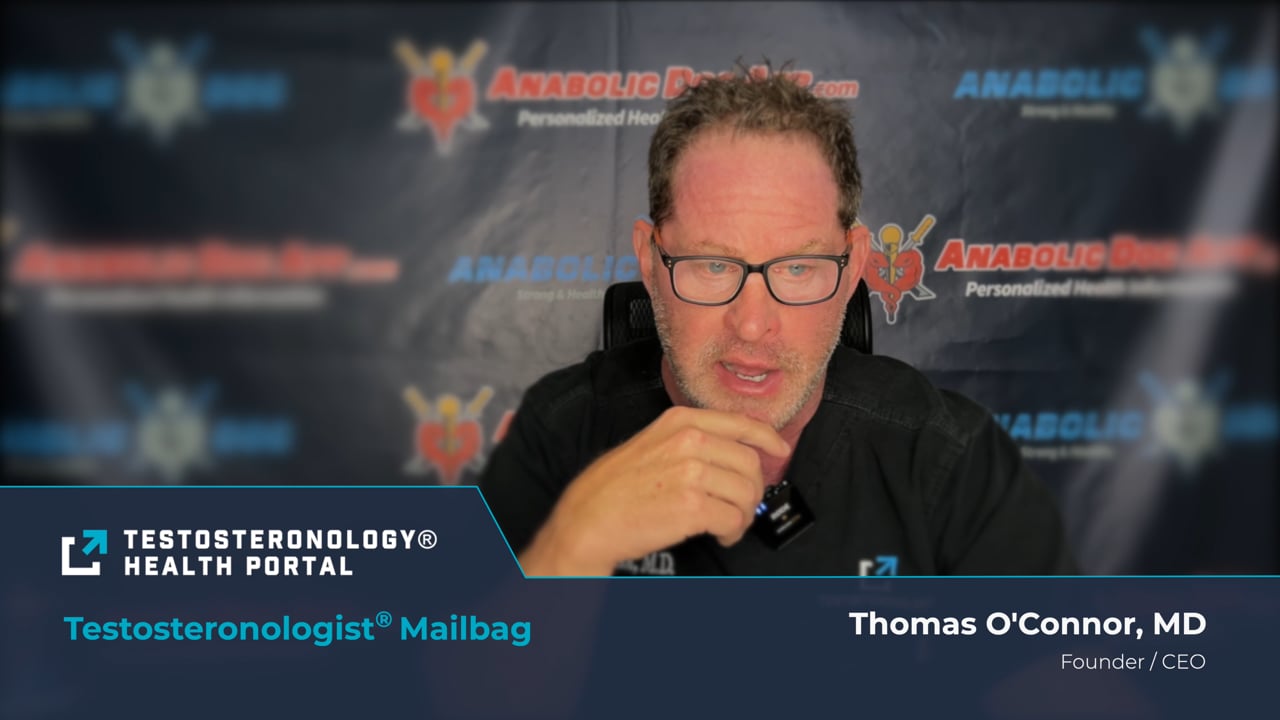
Can You Stay Fertile On 200 Mg Of Testosterone?

Viewing This Video Is A Member Exclusive Feature

But you don’t need membership to get Dr. O’Connor’s insight on this topic, it’s in the summary, key takeaways, and related drugs and conditions below.

Want to watch the full video? Join the Health Portal Today.

Join Now

Timeline

Timestamp
Topic
00:00
A 39-year-old man on TRT for eight years asks whether he can remain fertile on testosterone, and Dr. O’Connor discusses semen analysis, temporarily stopping TRT, HCG, Clomid, and specialist fertility treatment if conception does not occur.

Video Summary

A 39-year-old man on long-term TRT asks whether fertility is possible without stopping testosterone. Dr. O’Connor explains that fertility may initially persist with HCG, but continued testosterone suppression can eventually reduce sperm production, making semen analysis important before assuming fertility remains intact.

Because the member has already used TRT for eight years and does not want to stop, Dr. O’Connor discusses coming off testosterone temporarily and using higher-dose HCG with low-dose Clomid to stimulate testicular and reproductive function. He notes that an aromatase inhibitor may occasionally be needed if estrogen-related problems develop.

If conception does not occur after several ovulation cycles or roughly six months, Dr. O’Connor recommends working with a fertility specialist. More advanced treatment may include recombinant LH or FSH analogs when standard fertility-restoration approaches are unsuccessful.

Drug Callouts

Drug
Description
Testosterone
The member has used TRT for eight years and asks whether fertility can be maintained while continuing testosterone. Dr. O’Connor explains that exogenous testosterone can suppress reproductive function over time and discusses temporarily stopping treatment when conception becomes the goal.
Human Chorionic Gonadotropin (HCG)
HCG is the primary fertility medication discussed, with Dr. O’Connor describing approximately 1,500 to 2,500 units every other day after coming off testosterone to stimulate testicular function.
Clomid (Clomiphene)
Dr. O’Connor discusses combining approximately 25 mg of Clomid with HCG during fertility restoration after stopping testosterone.
Recombinant LH Analogs
Recombinant LH analogs are discussed as more advanced fertility treatments that specialists may use when standard HCG and Clomid approaches are insufficient.
Recombinant FSH Analogs
Recombinant FSH analogs are discussed as specialist fertility medications that can provide additional stimulation of sperm production when simpler approaches are unsuccessful.

Condition Callouts

Condition
Description
Fertility Impairment
Long-term testosterone use can suppress fertility even when sperm production may persist during the earlier stages of TRT.

Key Takeaways

  • Long-term testosterone use can suppress fertility even when sperm production may persist during the earlier stages of TRT.
  • A semen analysis is the most direct way to determine whether meaningful sperm production remains after years of testosterone use.
  • Dr. O’Connor discusses temporarily stopping testosterone and using HCG with low-dose Clomid when actively trying to conceive.
  • If pregnancy does not occur after several ovulation cycles or roughly six months, specialist fertility care may be needed.
  • Recombinant LH and FSH analogs are advanced options that fertility specialists may use when standard treatment does not restore adequate fertility.